

Last checked: October 2026
A caddie book (also spelled caddy book) is the hole-by-hole guide to a tournament course: a course map plus one page per hole with distance, par, OB, mandos and the hole's rules. To make one, map the competition layout early (tees, targets, fairway shapes), then walk the course with a phone or tablet to pin down OB lines and mandos exactly, add the hole rules, and publish it at least a week before the event. Publish it digitally, through a QR code on a sign or banner, so you can still fix mistakes after the signs are printed, and keep a PDF as an offline backup.
What a caddie book is, and why your event needs one
A caddie book tells players everything that matters about the competition course, hole by hole. It is also your event's business card: players and spectators judge how professional the event is by it.
Accuracy matters most. Many players arrive with one practice round or none, so the caddie book is how they learn where OB is and how far the target really is. A clear caddie book prevents wrong play on the course and makes the event easy for spectators to follow.
Start early: the caddie book is part of course planning
Don't treat the caddie book as a last-minute design job. It comes out of planning the competition course, so start both at the same time: ideally months before the event, and at least several weeks.
- Place tees and targets on the map and draw the fairway shapes.
- Decide what changes from the course's everyday layout. Do you need extra targets or temporary tee pads?
- Request PDGA waivers early if the layout uses non-standard rules, such as an island green or a forced drop zone that limits how players can play an OB throw. The PDGA must approve these before the event; without a waiver, the hole can be thrown out of scores and ratings. See the PDGA's Use of Non-Standard Rules and the Competition Manual. Every approved special rule then goes into the caddie book.
Get it accurate: map first, then walk the course
For most players, accuracy is what makes a caddie book good. The most reliable method we know:
- Do the first mapping on a computer. Place tees, targets and fairways on a satellite map.
- Walk the course with a phone or tablet and set the critical elements at their real GPS positions: OB lines, mandos, drop zones, key trees and rocks.
When every element sits on a GPS point, the distances between them are right too. An OB line drawn by eye in the middle of a fairway can be off by as much as 100 feet (30 m). That's how players end up frustrated, or penalized. Be especially exact with OB lines, fairway shapes and distances at events where players can't play several practice rounds.
Parkdly works this way: every element, whether a target, a mando, a tree or a rock, is placed at a GPS point, and distances are calculated from them.
What goes in a caddie book
At its simplest: a course map and a page for every hole.
- Course map: all holes at a glance, the number of holes, the order of play, and the big picture of the course.
- Hole pages: hole number, distance, par, a drawing of the hole (with elevation), and the elements that matter for play: OB areas, mandos, drop zones, and the hole's rules in words. The same rules as a good tee sign apply, and mark regulated areas in the PDGA colors.
Depending on the event, add:
- Event-specific rules. At the 2026 USDGC, some holes had A and B target positions: A positions were played on rounds 1 and 4, B positions on rounds 2 and 3, and the target was raised on some days and not on others. Rules like these belong in the caddie book.
- Different layouts per division. If divisions play nearly the same layout, cover the differences in one caddie book. If several holes differ, make a caddie book per layout and link them from one event page, like Masters Worlds did.
- A rules summary. Players who know the course often only want the exceptions. A text summary of hole rules serves them.
- Sponsor logos (see below).
Keep it simple. Every extra element competes with the information players need. Parking, schedules and other arrival info belong on the event's other channels; a caddie book is for playing the course. Only add general visitor info if the event has no other way to share it.
Choose the format: printed, QR, digital or PDF
| Format | Best for | Watch out for |
|---|---|---|
| Printed hole signs | The clearest and most common choice; nothing for players to load. See tee sign materials. | Hard to change once printed |
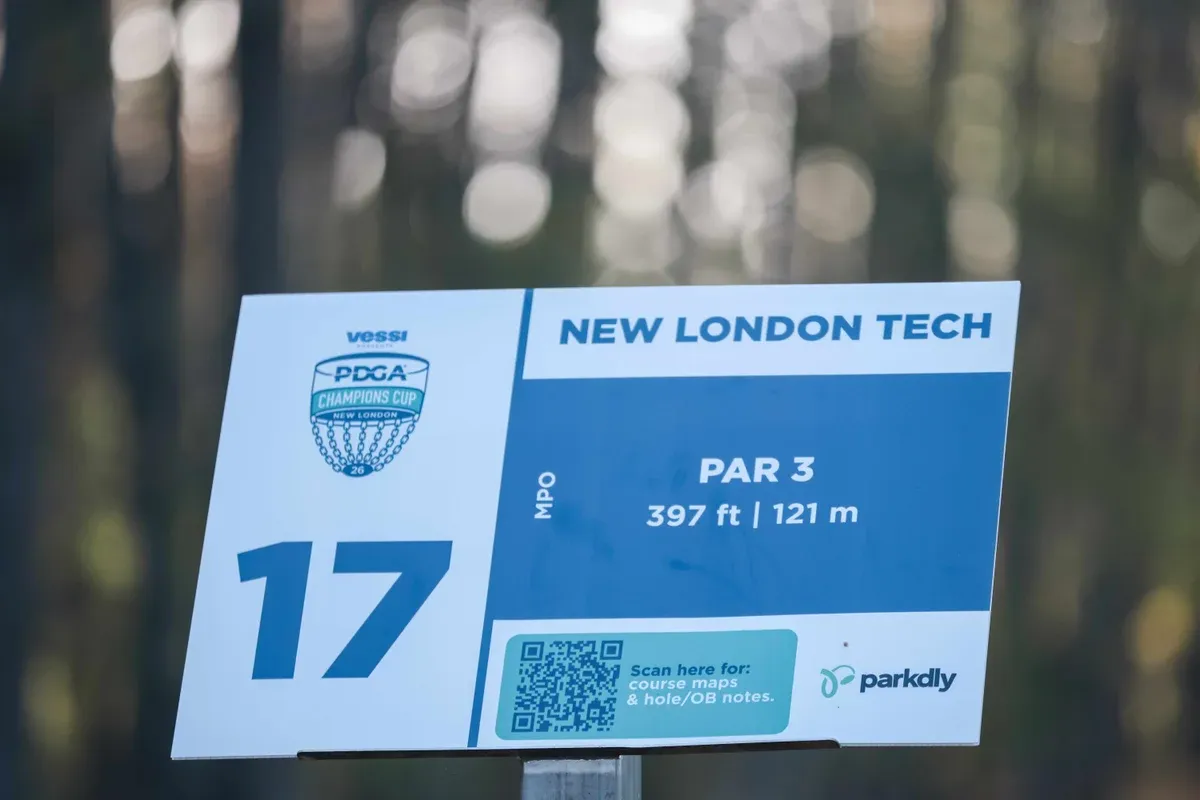
| Sign or banner with a QR code to a digital caddie book | Printing early and still fixing mistakes, missing hole rules or relief areas until the event. Used at the PDGA Majors throughout the 2026 season. | Players need a phone with signal |
| Digital only, no signs on the course | The lowest cost: nothing to print or install. Players see their own location on the map, so they find their way easily. | Weak mobile signal on the course |
| An offline backup players download in advance | Can't be updated once shared |
Our recommendation: a simple printed sign or banner with a QR code pointing to a digital caddie book, plus a PDF backup. Whatever you choose, make clear which version is the master.
Make it look like your sponsor's event
Secure sponsors as early as you can. A caddie book is a great way to show a prospective sponsor what the event will look like in their brand. Brand it fully: their colors and logo throughout. More on this in how to add sponsors to tee signs.
Common mistakes
- Clutter. Too much on a page, and the information players need gets lost.
- Outdated information. Changes made after printing never reach players, or no one knows which version is current. Go digital, or say clearly where the master version is.
- Not accurate enough. An OB line off by 100 feet (30 m) frustrates players.
- Too many rules, too small to read. When a hole carries more rules than players can follow, the rules box gets long and the text shrinks. If players have to zoom in on a phone to read OB notes and hole rules, cut the rules or move the detail to a rules summary.
- Published too late. Players want the caddie book a week or more before the event. Give them time to study it.
How to make one in Parkdly
- Build the course: place holes (tees and targets), shape the fairways, then add mandos, drop zones, OB and other boundaries.
- Walk the course with Parkdly on your phone or tablet and fix the positions of the critical elements on the spot.
- Check each tee sign: distance, par, notes and hole rules.
- Create a caddie book per division if layouts differ, and pick which signs each one includes.
- Brand it: cover, colors, and your sponsor's logo.
- Publish: you get a live link for your QR code and a PDF link that always downloads the latest version. List the books on your event's public page.
Step by step: Caddie Books in the Parkdly docs. For a real event, see how Parkdly was used at PDGA Pro Worlds 2025.
Next year, start from this year's work
An event that comes back next year doesn't have to start from scratch. The course, its holes and its caddie books stay in Parkdly, so next year you update what changed instead of rebuilding. Nothing is deleted if you cancel or move to a smaller plan between events: courses are locked, not deleted, and open again when you subscribe. Published caddie books are offline while the plan is inactive.
FAQ
Is it "caddie book" or "caddy book"? Both spellings mean the same thing. "Caddie book" is the spelling used in PDGA material and in Parkdly; many players search for "caddy book".
When should I publish the caddie book? At least a week before the event, so players can study the course. If you print signs, have the content final about two weeks before the event so there's time to print and install them.
Do I need physical signs if I have a digital caddie book? No. A digital caddie book can replace signs entirely, which is the cheapest option, but check the mobile signal first and offer a PDF backup.
What should a caddie book include? A course map, and for each hole: number, distance, par, a drawing with OB, mandos and drop zones, and the hole's rules.
Parkdly is the disc golf course design app for professional tee signs, course maps and caddie books, built for course owners, designers and tournament directors.